AI sounds more human when your prompt names the reader, the format and the tone, bans specific overused words and sentence patterns, and gets refined over several rounds. You can paste your own writing too, but research finds machine-text markers survive even when models imitate a human text. Detectors vary widely, so a human edit still decides the result.
Key takeaways
- OpenAI's ChatGPT guidance asks for clear, specific prompts with enough context, and for tone named in adjectives such as formal, friendly or serious.
- Research ties LLM text to standardized grammar, a dense noun-heavy style, -ing clauses and overused words such as "intricate" and "underscore".
- Lists of AI words go stale: in GPT-4o-mini, "boasts" was no longer overused and "underscore" had risen.
- In one study, models given the first 500 tokens of a human text and asked to continue in the same style still showed machine style markers.
- Detectors disagree with each other: in one test, GPTZero was close to perfect while HIX AI labeled almost every sample human.
The prompts to make AI write like a human that work best are specific. They name the reader, the format and the tone. They can include a sample of your own writing and list the words and sentence patterns to drop. Then they get refined over several rounds. A bare “make it sound human” gives the model almost nothing to work with.
No prompt makes machine text impossible to tell from yours. A large study of 11 language models across 8 genres found that the key stylistic markers of LLM text held up across generation conditions, including prompt settings meant to nudge models toward human-like text. Plan to edit whatever comes back.
| What you want | Prompt move | What the evidence says |
|---|---|---|
| Output that fits the job | Be clear and specific, and give context | OpenAI’s ChatGPT guidance asks for “enough context for the model to understand what you are asking” |
| The right tone | Name the tone in adjectives | OpenAI suggests “formal, informal, friendly, professional, humorous, or serious” |
| Fewer stock words | Give an avoid list and regenerate until it’s clean | Researchers had ChatGPT-3.5 revise abstracts until none of their blocked words appeared |
| Your voice | Paste samples of your own writing, then check the result | Models asked to continue a human text in its style still showed machine markers |
| Better drafts | Refine in rounds | OpenAI says prompting “often requires an iterative approach” |
| Passing detectors | Don’t count on it | One test found one commercial detector near-perfect and another labeling almost everything human |
Why does AI writing sound like AI?
AI writing sounds like AI because chat models default to a more standardized, denser style than people use, and they lean on a short list of favorite words. A stylometry study of short texts found that LLM output tends to show “more grammatical standardization” and may overuse certain words or punctuation marks compared with human writing.
Two larger studies point the same way. An analysis of human and machine texts from 11 LLMs across 8 domains found that human writing tends to have simpler syntax and more diverse content, and that humans showed greater variation than the models. The same paper found that newer models produce similarly variable text, “pointing to an homogenization of machine-generated texts.”
A third paper, on stylistic variation across genres, models and decoding strategies, found LLM outputs to be “more information dense and noun-heavy,” especially from instruction-tuned chat models. It traced that to a handful of grammatical habits. Present participial clauses are the “, making it easier to…” tail on a sentence. Nominalizations turn verbs into nouns, as in “the implementation of” instead of “implement”. The models also favored “that” clauses as subjects and phrasal coordination, which means stacked pairs like “clear and concise.”
Why does ChatGPT overuse certain words?
ChatGPT’s habit of repeating certain words shows up clearly in published research, though the cause is still an open question. A study of over 15 million PubMed abstracts from 2010 to 2024 found that LLMs “led to an abrupt increase in the frequency of certain style words.” It estimated that at least 13.5% of 2024 abstracts were processed with LLMs, reaching 40% in some subcorpora. Writing about an earlier version of that paper, Language Log quoted Ars Technica: “showcasing” and “underscores” rose ninefold against the pre-LLM trend, and the word leading the list appeared in 25 times as many 2024 papers as that trend predicted.
15 million
PubMed abstracts from 2010 to 2024 analysed for style words
Source: arxiv.org, as of Nov 29, 2026
14%
Minimum share of 2024 abstracts estimated to be processed with LLMs
Source: arxiv.org, as of Nov 29, 2026
40%
Estimated share reached in some subcorpora
Source: arxiv.org, as of Nov 29, 2026
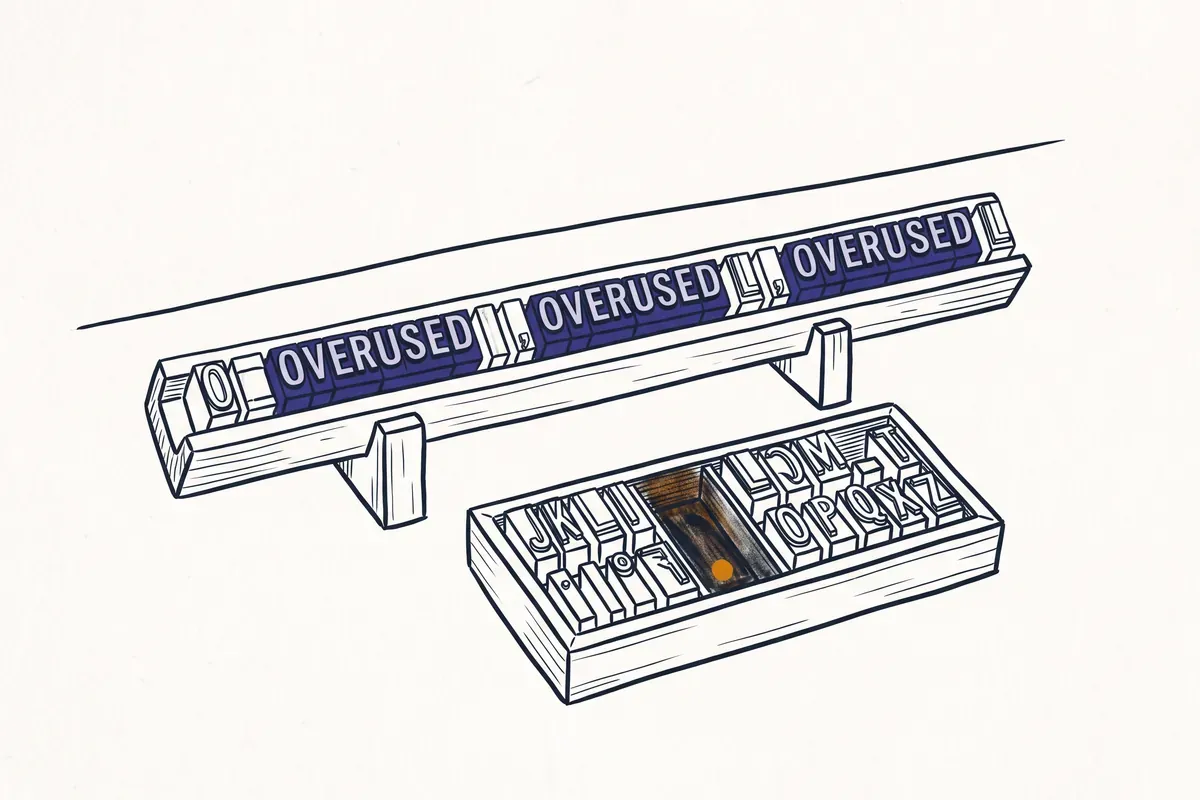
A team that asked why ChatGPT overuses certain words identified 21 focal words, including “intricate” and “underscore.” They failed to find evidence that model architecture, algorithm choices or training data caused the overuse. Their model testing was “consistent with RLHF playing a role,” and they ran an exploratory online study as well. RLHF (reinforcement learning from human feedback) is the training stage where people rate responses and the model learns to produce the kind they rated highly.
Treat any list of “AI words” as dated. The same researchers found that in GPT-4o-mini, “boasts” was no longer overused and “underscore” had increased significantly. Some spikes have nothing to do with AI: “mash” rose tenfold in abstracts, yet ChatGPT isn’t known to overuse it. Language Log also notes that the top word on these lists has been gaining in the Corpus of Historical American English since the 1940s. A listed word flags a sentence to reread. It proves nothing about who wrote it.
What makes a prompt produce human-sounding writing?
A prompt produces human-sounding writing when it removes the guesswork: who reads it, what it’s for, what format it takes and what tone to use. OpenAI’s prompt engineering best practices for ChatGPT put it plainly: “Ensure your prompts are clear, specific, and provide enough context for the model to understand what you are asking.”
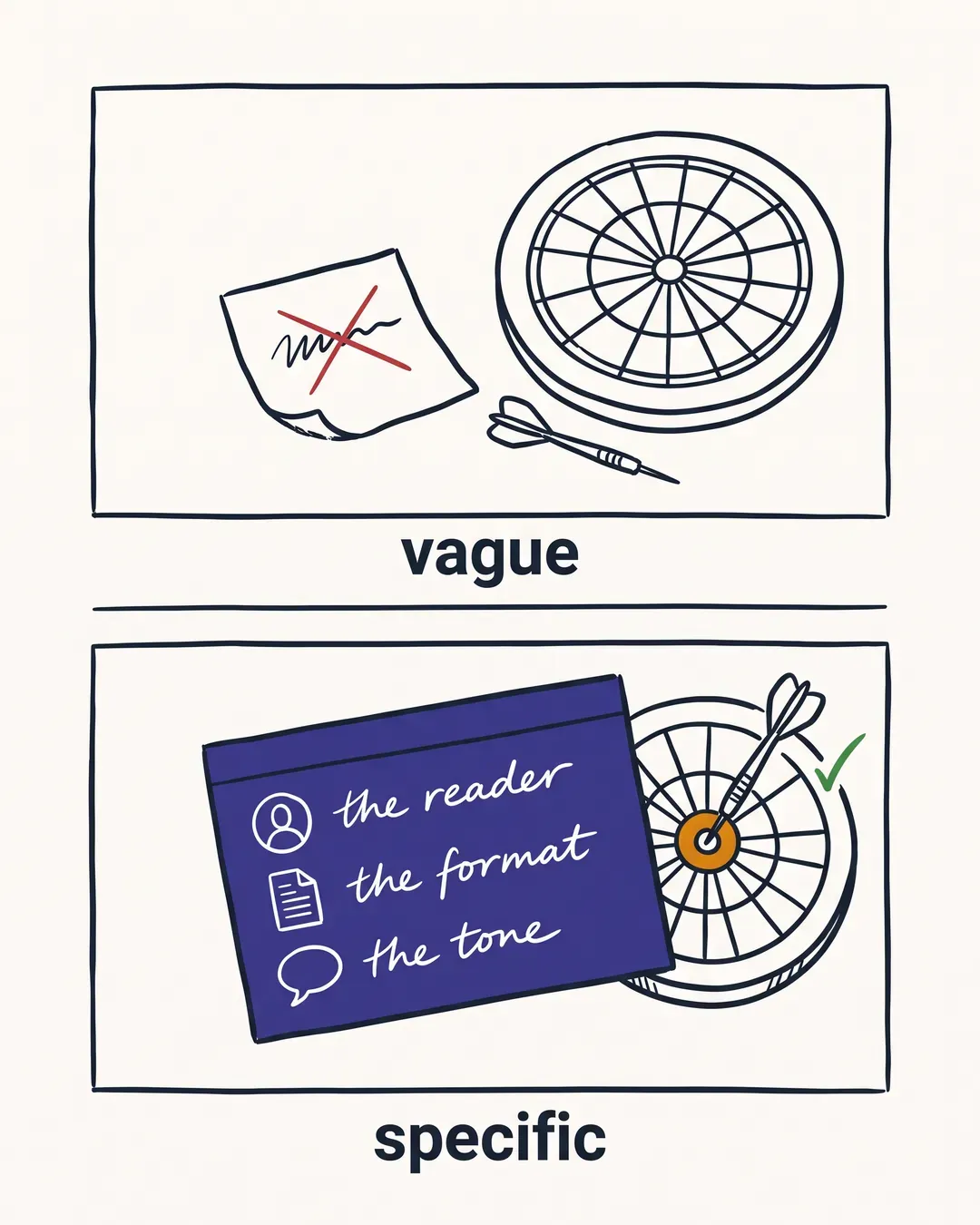
For tone, the same help article recommends descriptive adjectives and gives the sample instruction “Explain this in a friendly and engaging tone.” “Human” doesn’t describe a tone. “Friendly and blunt” does.
Name the format too. One research team writes that LLM outputs “are highly dependent on the domain and style requested by the prompt.” The Biber-feature analysis found that genre shaped style more than whether a person or a particular model wrote the text. “A short LinkedIn post for other freelance designers” gives the model a target. “A post about pricing” doesn’t.
Context also means the raw material. If you want a post about losing a client, the prompt needs the type of client, what went wrong and what you changed. Leave those out and the model fills the gap with general statements. OpenAI’s own GPT-6.2 announcement presents “fewer generic takeaways and less filler” as an improvement in GPT‑6.2 Astra.
How do you get AI to write in your own voice?
To ask AI for your own voice, paste real samples of your writing, ask it to match them, and then check the result against your own habits. Research finds that some machine habits stay even when a model is asked to imitate a human text.
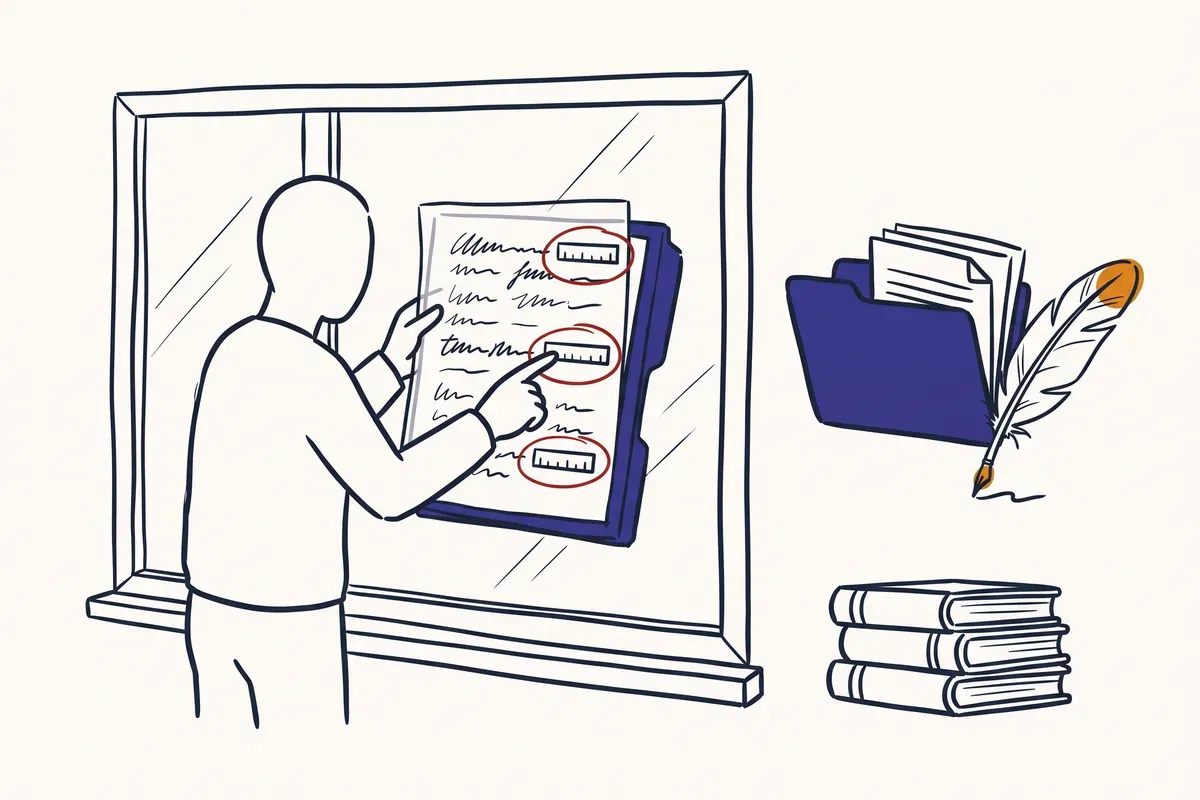
In that research, summarized in the study of stylistic variation, instruction-tuned models were given the first 500 tokens of a human-written text with this prompt: “In the same style, tone, and diction of the following text, complete the next 500 words.” The models still favored present participial clauses, nominalization and phrasal coordination, the same features found in models that were never asked to imitate anyone.
If you’d rather describe your voice than paste it every time, a writing style analyzer can turn three to ten samples into a brief covering your sentence length, openings and repeated phrases, which you can then paste into any prompt. A personal style guide for AI built from that brief saves you rewriting the instructions for each piece.
OpenAI makes a related claim about templates for its newest model. It says GPT‑6.2 Astra’s documents “read less like AI, and more closely follow the templates you provide,” and that for slides it can “carry the template’s writing style into new slides.” Those are the vendor’s claims about its own model, so test them against your samples.
What are good prompts to make AI write like a human?
Good prompts give the model your facts, your reader and your rules in one place. The templates below are examples to paste into ChatGPT, Claude or another chat tool. Replace each bracketed part with your own details.
Example: voice-sample prompt
I'm going to give you three samples of my writing. Study them for sentence length, word choice, how I open a piece and how formal I am.

[Sample 1]
[Sample 2]
[Sample 3]

Now write a [format, length] for [reader] about [topic]. Use these facts and no others: [facts]. Match my samples: where I use short sentences or contractions, do the same. Don't add opinions I haven't given you.
Example: avoid-list prompt
Write a [format] about [topic] for [reader]. Rules:
- Don't use these words: intricate, underscore, showcase, surpass, boast, crucial.
- Don't end a sentence with an -ing phrase such as ", making it easier to..." or ", highlighting...". Start a new sentence instead.
- Use verbs, not noun phrases: "decide" instead of "make a decision", "implement" instead of "the implementation of".
- Pick one word instead of a pair like "clear and concise".
- Mix short sentences with longer ones.
When you finish, check your draft against these rules and rewrite every sentence that breaks one.
Example: rewrite prompt
Here is a draft that reads like AI wrote it: [paste draft]

Rewrite it so it sounds like a person talking to [reader]. Keep every fact. Cut words that add nothing. Replace general claims with the specific details already in the draft. If a sentence has no specific detail, flag it instead of inventing one. List the sentences you cut.
Example: audience prompt
You're writing for [reader: their role, what they already know, what worries them]. They'll read this on [where], in about [time]. Tone: [two adjectives, e.g. friendly and direct]. Write a [format] about [topic]. Leave out anything this reader already knows.How do you make AI not write like AI?
To make AI not write like AI, tell it to avoid the specific features research ties to machine text, and name each one concretely. “Avoid clichés” leaves the model guessing. These are worth banning or limiting:
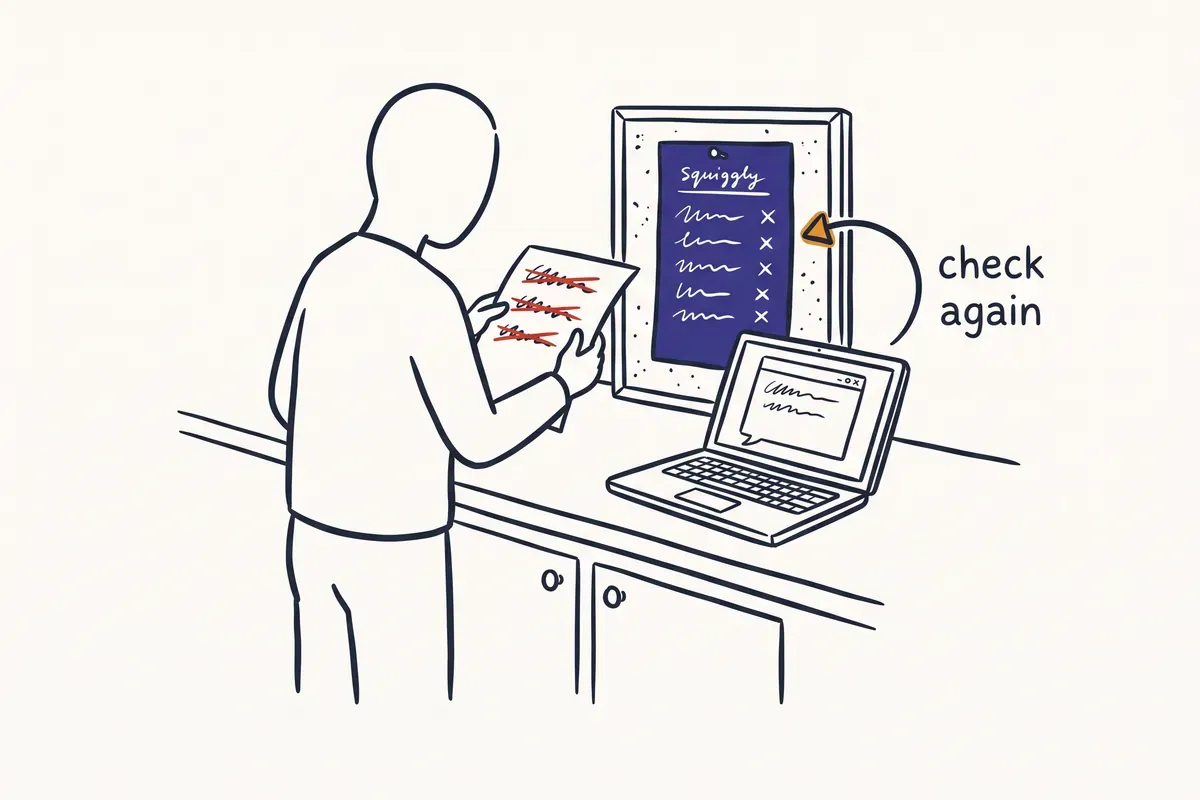
- Overused words. “Intricate,” “underscore,” “showcasing” and “surpass” all appear in the focal-word research and the PubMed counts. Ask for plain swaps: “complex” for “intricate,” “show” for “showcasing.”
- -ing tails. Present participial clauses are among the most overused features in chat models. Ask for a separate sentence instead.
- Noun-heavy phrasing. Nominalizations make text denser. Ask for the verb.
- Stacked pairs. Phrasal coordination is on the same overused list. Ask the model to keep the stronger word.
- Sameness. Humans show more variation than models. Ask for varied sentence lengths and openings.
- Repeated punctuation. LLM text may overuse certain punctuation marks. If every paragraph leans on the same mark, for example a dash, ask the model to cut back.
Avoid lists work when you enforce them. The researchers who studied overused words asked ChatGPT-3.5 for abstracts “making sure not to use words such as [list of blockwords],” and their script kept prompting it to generate and revise “until it contained none of the blockwords.” You can do the same by hand: when the draft comes back, ask the model to check it against your list and rewrite any sentence that breaks a rule.
Once the draft is back, paste it into a tone checker to catch phrases and patterns that read as machine-made. A guide to the signs of AI writing covers fixes for each type.
Example: before and after
Before (an invented draft, written for this illustration):
Before
We're excited to share our new client onboarding process, which showcases our commitment to delivering crucial value from day one. This initiative underscores the importance of clear communication and transparency and ensures a smooth experience for every client.
After
New clients now get a 20-minute kickoff call within two days of signing, plus one shared doc with every deadline in it. We changed this because two clients told us last quarter they didn't know who to email. Now they know.
We’re excited to share our new client onboarding process, which showcases our commitment to delivering crucial value from day one. This initiative underscores the importance of clear communication and transparency and ensures a smooth experience for every client.
This version has three listed words (“showcases,” “crucial,” “underscores”), a nominalization (“communication”) and a stacked pair.
The rewrite used the avoid-list prompt plus three facts from the writer’s own situation: clients now get a 20-minute kickoff call within two days of signing; they get one shared doc with every deadline; last quarter two clients said they didn’t know who to email.
After:
New clients now get a 20-minute kickoff call within two days of signing, plus one shared doc with every deadline in it. We changed this because two clients told us last quarter they didn’t know who to email. Now they know.
Most of the improvement comes from the three facts in the prompt. The word bans only cleared away the filler. A model can’t invent those details honestly, so they have to come from you.
Why should you revise in rounds instead of relying on one prompt?
Revising in rounds lets you see what the model got wrong and fix it in the next prompt. OpenAI’s help article says prompt engineering “often requires an iterative approach”: start with an initial prompt, review the response, and refine the prompt based on the output.
- Content: ask for a draft built only from your facts, then check that nothing is missing or made up.
- Voice: paste your samples and ask for a rewrite in that style.
- Avoid list: have the model check the draft against your banned words and patterns, then rewrite the sentences that break them.
- Your edit: read it aloud and change anything you wouldn't say.
A round plan for a post or an email:
Keep each follow-up short. “Cut the last paragraph” or “Make the second sentence blunter” gives the model one clear job. If a long chat starts drifting, open a new one and paste your best version with your rules at the top.
Does the model you use change how human it sounds?
The model you pick shapes style more than some settings do. The Biber-feature analysis found that model choice had a larger effect on style than decoding strategy, with some exceptions. It also found that chat versions of the models tend to cluster together in stylistic space, and that instruction-tuned models are frequently clustered apart from base models and human text. Some models sat closer to human writing than others: the paper gives Cohere as an example, with feature usage ratios “consistently closer to 1.”
OpenAI now markets more natural writing. The OpenAI homepage dates the GPT‑6.2 Astra and Sol launch to November 17, 2026. In its announcement, OpenAI says GPT‑6.2 Sol “writes clearly and naturally” and that GPT‑6.2 Astra’s writing is “more direct and specific.” Both are available to Plus, Pro, Enterprise and Edu users in ChatGPT Work and Codex; eligible Enterprise and Edu users get access once their workspace admin enables it. Treat these as claims to test with your own prompts and samples.
Will human-sounding prompts get past AI detectors?
Human-sounding prompts may or may not get past AI detectors, and in one test two commercial detectors gave very different results. A stylometry study that tested two commercial detectors ran each on 100 samples per model plus 100 human texts. GPTZero sorted human and model text almost perfectly. A classifier from HIX AI “classifies almost every sample as written by humans.”
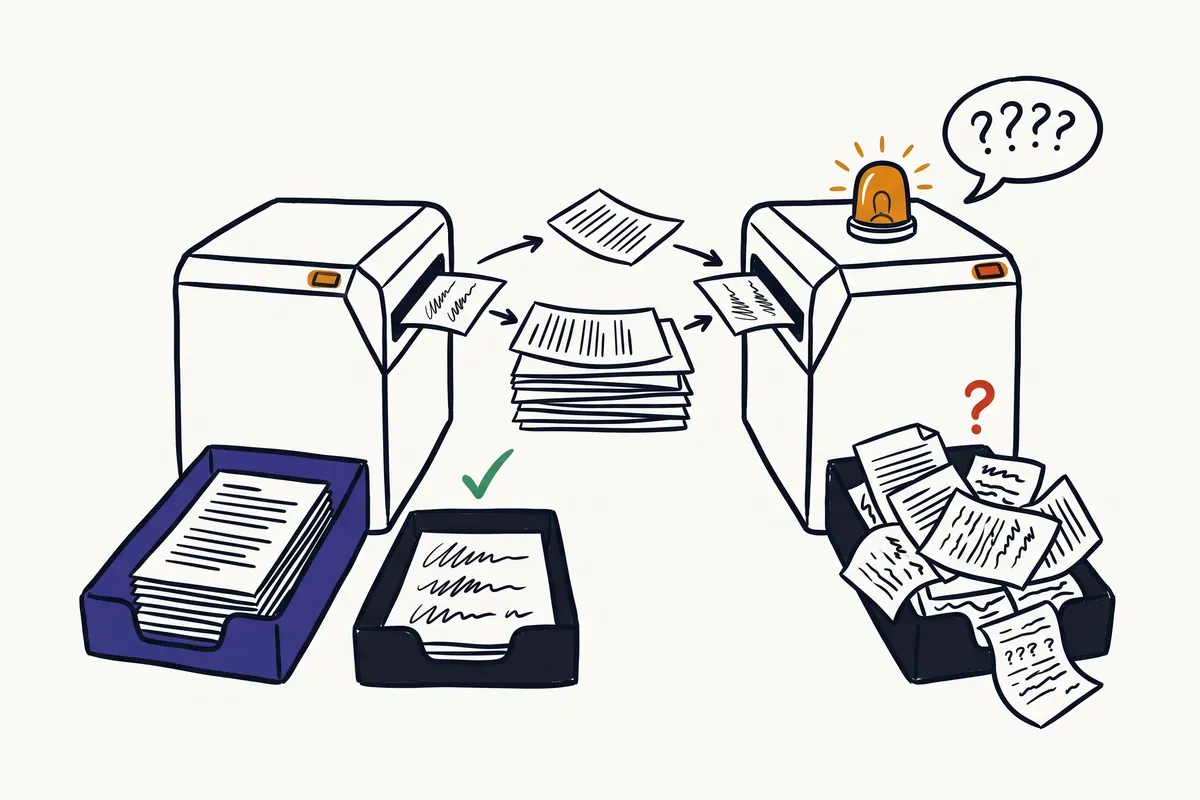
Prompting doesn’t reliably hide the signals. In the study of stylistic variation, the key differences held across generation conditions, including prompts nudging models toward human-like text. StyleDecipher, a detection method, reported that most samples stayed distinguishable after adversarial changes meant to blur them. The same paper names detection’s weak spots. Many detectors depend on one model’s output, which limits them against newer models or “hybrid human-AI content,” and watermarking “is fragile under text manipulations like paraphrasing.”
Some researchers warn against using style signals to judge people. The authors of the linguistic profiling study “strongly caution against” using their features in high-stakes decisions or anywhere they “could disadvantage individuals based on their language competency.” The stylometry researchers add that detecting machine-generated text “does not imply that it is untrustworthy or malicious.”
If your school, client or publisher bans AI-written work, a human tone doesn’t make the work allowed. Read the policy and disclose AI use where it asks you to. If a tool flagged writing you did yourself, a guide to handling an AI detector false positive covers what to do next.
What still needs a human edit?
A human edit still has to cover the facts, the specifics only you know and anything presented as your experience. The excess-vocabulary paper opens by noting that LLMs “can produce inaccurate information, reinforce existing biases, and be easily misused.” Polished prose makes errors harder to spot: the focal-word researchers describe a “decoupling of form and content,” because fluent style no longer signals that the content is sound.
Checklist
- Every number, date, name and quote against where it came from
- Claims the model added that you never gave it
- Stories and opinions: if the draft says "I learned," you need to have learned it
- The details only you have: the client, the price, the mistake and what you'd do differently
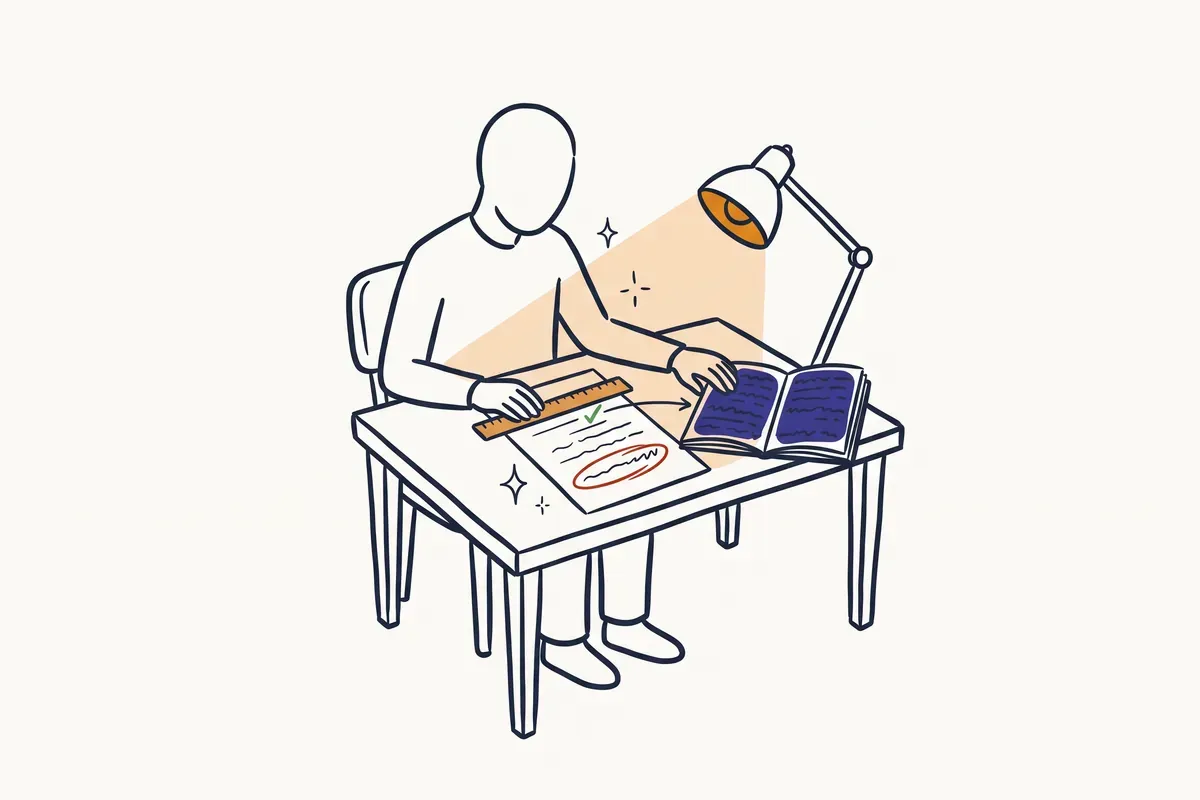
Before you publish, check:
- every number, date, name and quote against where it came from
- claims the model added that you never gave it
- stories and opinions: if the draft says “I learned,” you need to have learned it
- the details only you have, such as the client, the price, the mistake and what you’d do differently
What to do next
You can test these prompts on one real piece of writing today, starting with your own samples.
- Pick three pieces of your own writing in the format you need most and save them in one note.
- Write a short audience line: who reads this, what they already know, and two tone adjectives.
- Copy the avoid-list template, then add phrases you’ve noticed in your own AI drafts.
- Take one real piece through the rounds above, with one change per follow-up.
- Read the final version aloud and check every fact before it goes out.
- If AI use is restricted where you’ll submit, read that policy before you start.
Prices and features as of Nov 28, 2026, from each product's own pages.
Frequently asked questions
Is there one prompt that makes AI sound human?
No single prompt does it. OpenAI's help article expects you to work in rounds and suggests that between them you "adjust the wording, add more context, or simplify the request." Start with the voice-sample or avoid-list template and plan on at least one follow-up.
Which words give away AI writing?
Beyond rare words like "showcasing," common ones rose too: Language Log quoted reporting that "potential" rose 4.1 percentage points in post-LLM abstracts, "findings" 2.7 and "crucial" 2.6. Language Log also calculated that even if every PubMed citation containing a form of the word leading the list had been written by ChatGPT, that would cover just 0.59% of the year's citations. One word tells you very little on its own.
Does telling ChatGPT to 'sound human' work?
Not on its own. OpenAI's guidance says to "avoid ambiguity and be as precise as possible," and "human" doesn't describe a tone. Replace "sound human" with two tone adjectives and a line about who the reader is, then refine in follow-up rounds.
Why does ChatGPT overuse certain words?
One theory, reported by The Guardian and discussed on Language Log, holds that the top word on these lists is common in Nigerian English and many RLHF raters were hired in Nigeria. The researchers who studied focal words ran an initial analysis of the International Corpus of English and found it doesn't support that idea. Their online experiment also suggested people react to that one word differently than to other overused words.
Can AI detectors tell if text is AI?
Sometimes, with wide variation. Some detectors use statistics such as perplexity and probability curvature. Others, including GPTZero and OpenAI's Classifier, use trained deep learning models such as RoBERTa. In one stylometry test, GPT-4 text was told apart from human Wikipedia summaries only about 72% of the time.
How do you make Claude write naturally?
OpenAI's help article is written for ChatGPT, and the focal-word study worked with ChatGPT and Llama, not Claude. Those researchers report only an impression that ChatGPT and Llama overuse many of the same words, and they say a systematic investigation is needed. So build Claude's avoid list from Claude's own drafts: note the words and patterns it repeats, ban them by name, and ask it to check its draft against the list.
Sources
- Prompt engineering best practices for ChatGPT | OpenAI Help Center
- [2406.07016v5] Delving into LLM-assisted writing in biomedical publications through excess vocabulary
- Why Does ChatGPT “Delve” So Much? Exploring the Sources of Lexical Overrepresentation in Large Language Models
- Stylometry recognizes human and LLM-generated texts in short samples
- Linguistic and Embedding-Based Profiling of Texts generated by Humans and Large Language Models
- Interpretable Stylistic Variation in Human and LLM Writing Across Genres, Models, and Decoding Strategies
- StyleDecipher: Robust and Explainable Detection of LLM-Generated Texts with Stylistic Analysis
- Language Log » Are LLMs writing PubMed articles?
- OpenAI | Research & Deployment
- Introducing GPT-6.2 Astra and Sol | OpenAI