To get AI to write in your style, start by describing your habits: how your sentence lengths mix, your contractions, pronouns, punctuation and favorite words. Then give the tool several samples of the same kind of writing and save the description in ChatGPT's custom instructions or a project. Check every draft, because research finds AI still flattens informal, personal writing.
Key takeaways
- In one study, giving a model a few samples raised style-matching accuracy up to 23.5x over giving it none.
- AI can approximate everyday writers' styles in email and news but struggles with blogs and forum posts.
- AI rewrites cut contractions, function words and "I", even when you ask them to preserve your voice.
- In ChatGPT you can save your style in custom instructions (Profile > Personalize), in memory or in project instructions.
- In one study, asking a model to continue a text (completion prompting) reached 99.9% agreement with the original author's style.
Your AI writing style is the set of habits that make your writing recognizably yours: how long your sentences run, whether you use contractions, how often you say “I” and which punctuation you reach for. To get ChatGPT or any other tool to write like you, write those habits down, give the tool real samples of the same kind of writing, and save both where the tool can reuse them.
Expect a partial match. A September 2025 study of writing from more than 400 real-world authors found that AI models approximate personal style in emails and news but struggle with informal blogs and forums. The steps below show you what to describe, what to feed in and where to check for drift.
| Question | Short answer | Source |
|---|---|---|
| Can ChatGPT learn my style? | Partly. Custom instructions, memory, project instructions and pasted samples all shape its tone. | OpenAI Academy: Customizing ChatGPT |
| Do writing samples help? | Yes. In one study, few-shot prompts gave up to 23.5x higher style-matching accuracy than zero-shot prompts. | How Well Do LLMs Imitate Human Writing Style? |
| Can AI copy an everyday writer? | Roughly in email and news. Poorly in blogs and forum posts. | Catch Me If You Can? Not Yet |
| Can AI copy famous authors? | Imitations of Whitman, Wordsworth, Trump and Obama stayed highly detectable. | Decoding AI Authorship |
| Does AI editing change my voice? | Yes. Rewrites cut contractions, function words and first-person pronouns. Voice-preserving prompts shrink the change without removing it. | Voice Under Revision |
What is a writing style, and how is it different from voice and tone?
A writing style is the pattern of small choices that repeats across everything you write, and it can be measured. Stylometry, the field that identifies authors from their texts, looks at features such as how a writer uses punctuation, how often they write agentless passive sentences, and how much their vocabulary and sentence structure vary.
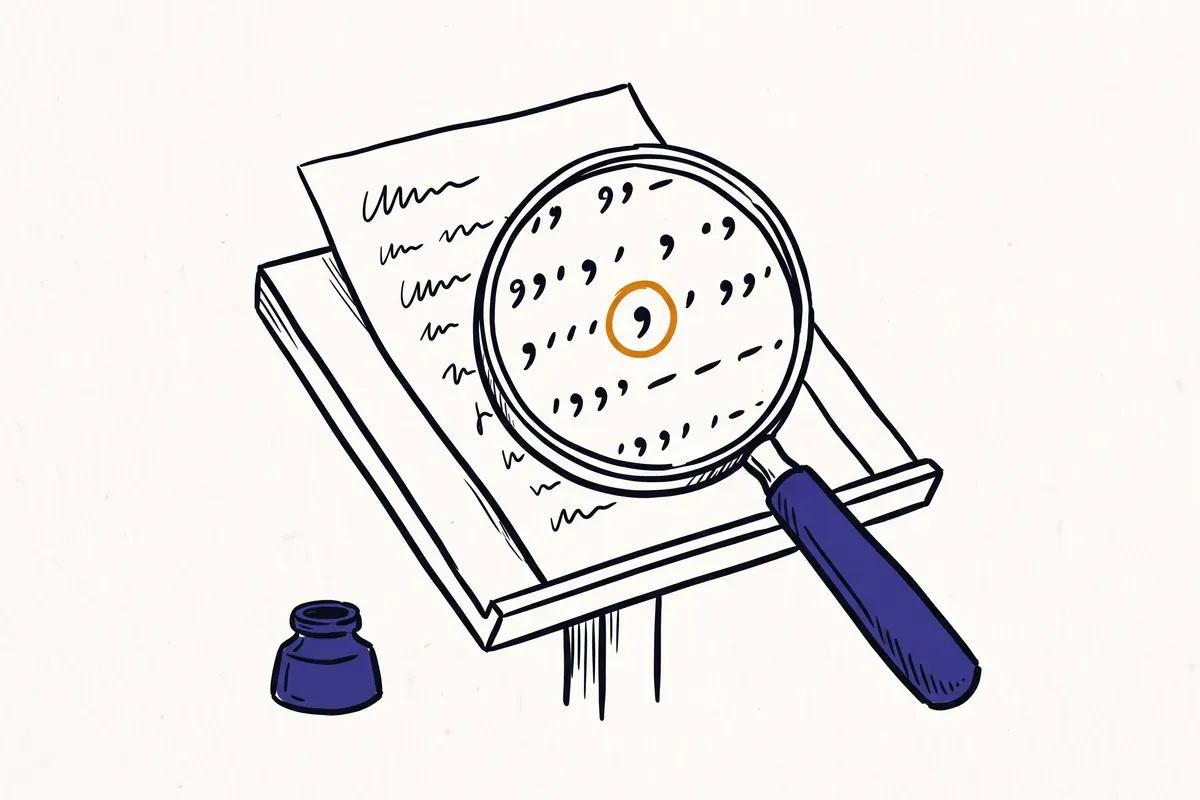
The habits that give a writer away are often tiny. In 1901, one researcher tried to tell John Fletcher’s work apart from Philip Massinger’s using Fletcher’s preference for “’em” over “them”, according to Wikipedia’s history of stylometry. The attempt failed because the edition of Massinger he used had an editor who expanded every “’em” to “them”. Modern methods care more about patterns in the most common words than about rare topical ones, which is useful to know: your “and”, “so” and “I” say more about you than your subject does.
Writing voice vs tone
For working with AI, these working definitions keep the terms apart:
| Term | What it means in this guide | Question to ask yourself |
|---|---|---|
| Style | Your countable habits | Do I write “I’ll” or “I will”? |
| Voice | How those habits add up to one recognizable person | Would a colleague know this was mine with my name removed? |
| Tone | The attitude of one piece, adjusted for its reader | Is this for a client, my team or my boss? |
Tone changes from piece to piece while voice stays put. One of OpenAI’s sample prompts asks ChatGPT to keep a style but shift it for a new audience: “Recreate this style but adjust slightly for a different audience, such as executives vs. frontline staff.”
How do you work out your own writing style before you bring in AI?
You work out your writing style by collecting writing you produced without AI help and noting the habits that repeat in it. Do this before you open a chatbot, because the tool can only copy what you can show or describe.
- Gather unedited samples you wrote yourself, skipping anything an AI tool polished.
- Look at sentence length as a mix, not an average.
- Count contractions and "I".
- Note your punctuation: which marks you use and which you never touch.
- List your openings and repeated phrases.
- Write down what you never do, including banned words.
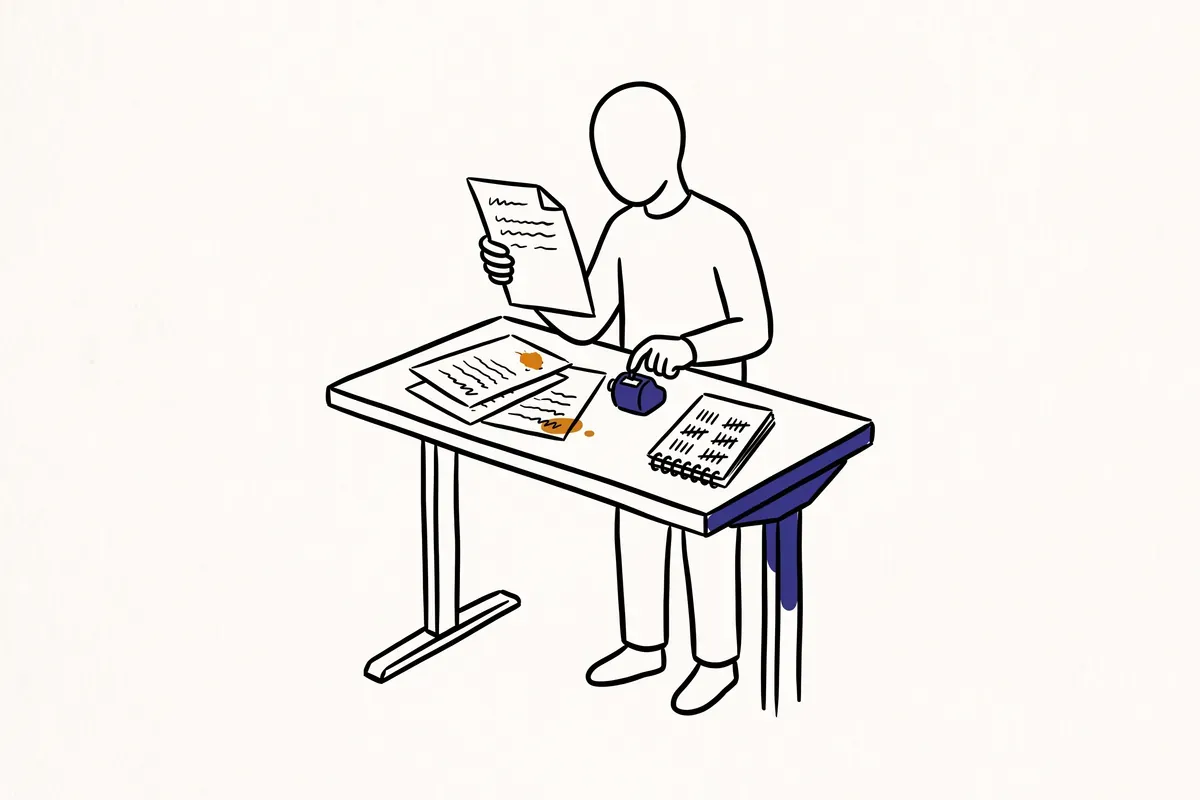
If counting by hand sounds slow, the free writing style analyzer on this site takes three to ten samples of one person’s writing and measures sentence length, openings, repeated phrases and habits, then returns them as a voice brief.
Which writing samples should you give an AI?
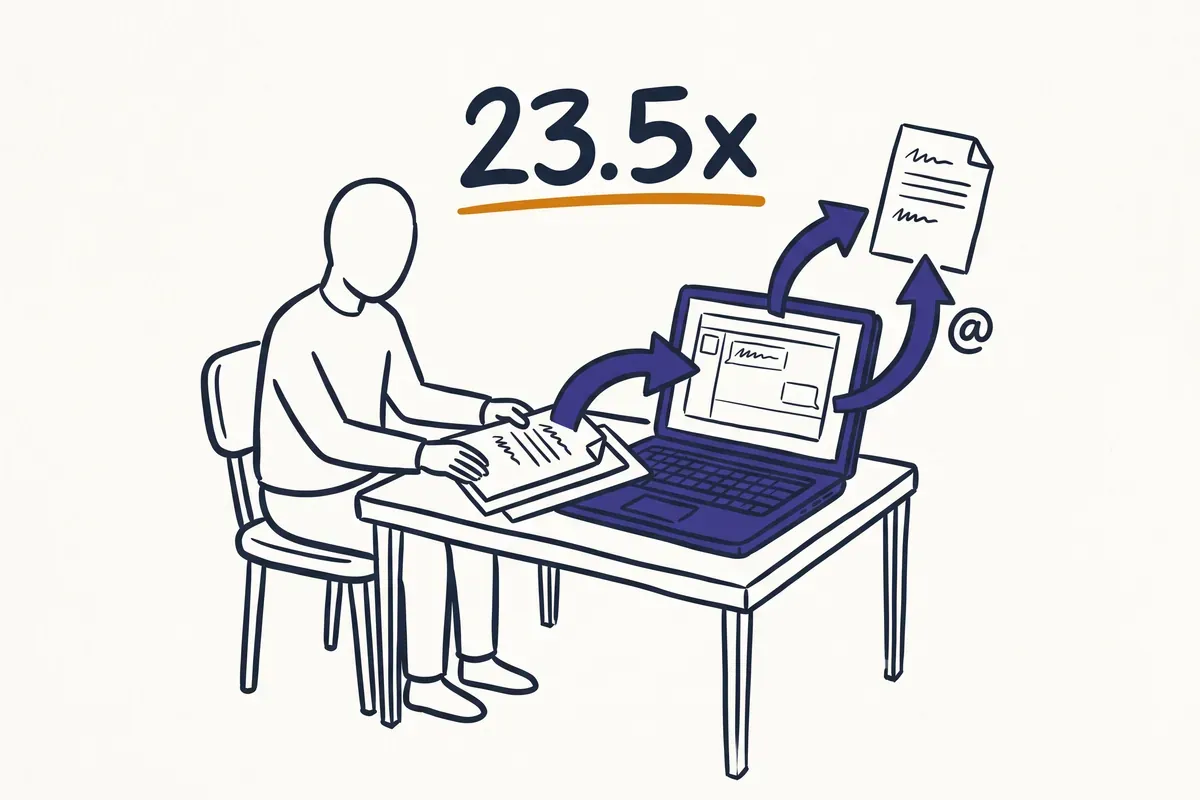
Give an AI several samples of the same kind of writing you want it to produce, all written by you before any AI editing. In a study of five models from the Llama, Qwen and Mixtral families, few-shot prompting gave up to 23.5x higher style-matching accuracy than zero-shot, and the prompting strategy mattered more than model size.
23.5 x
Up to this much higher style-matching accuracy with few-shot prompts than zero-shot
Source: arxiv.org, as of Nov 29, 2026
100%
Agreement with the original author's style using text completion
Source: arxiv.org, as of Nov 29, 2026
Use these rules when you pick:
- Match the format. Use past emails to get emails and past posts to get posts. The everyday-author study found models did better on structured formats like news and email than on blogs and forums, so plan on more editing for casual pieces.
- Leave out AI-edited work. Anything an AI tool rewrote has already been pulled toward the tool’s register (see the editing section below).
- Don’t count on volume alone. The same study found that analysis of prompting strategies “such as number of demonstrations” revealed key limitations in personalization.
One prompting approach stood out. In the five-model study, text completion (giving the model the start of a text and having it continue) reached 99.9% agreement with the original author’s style. You can try the same move: write your opening paragraph yourself, then ask the AI to continue in the same style.
You can also ask the AI to describe your samples. OpenAI suggests pasting your writing and asking: “Summarize my tone and style, including word choice, sentence length, and level of formality.” Compare its summary with your own notes and correct anything it got wrong before you save it.
How do you set up ChatGPT custom instructions to match your style?
ChatGPT custom instructions are the user-level setting where you describe your style once, so you don’t have to repeat it in every chat. According to OpenAI’s Academy guide to customizing ChatGPT, last updated October 6, 2026, you can set instructions at three levels: in your settings, in a project’s instructions, or in a single chat for a one-off change.
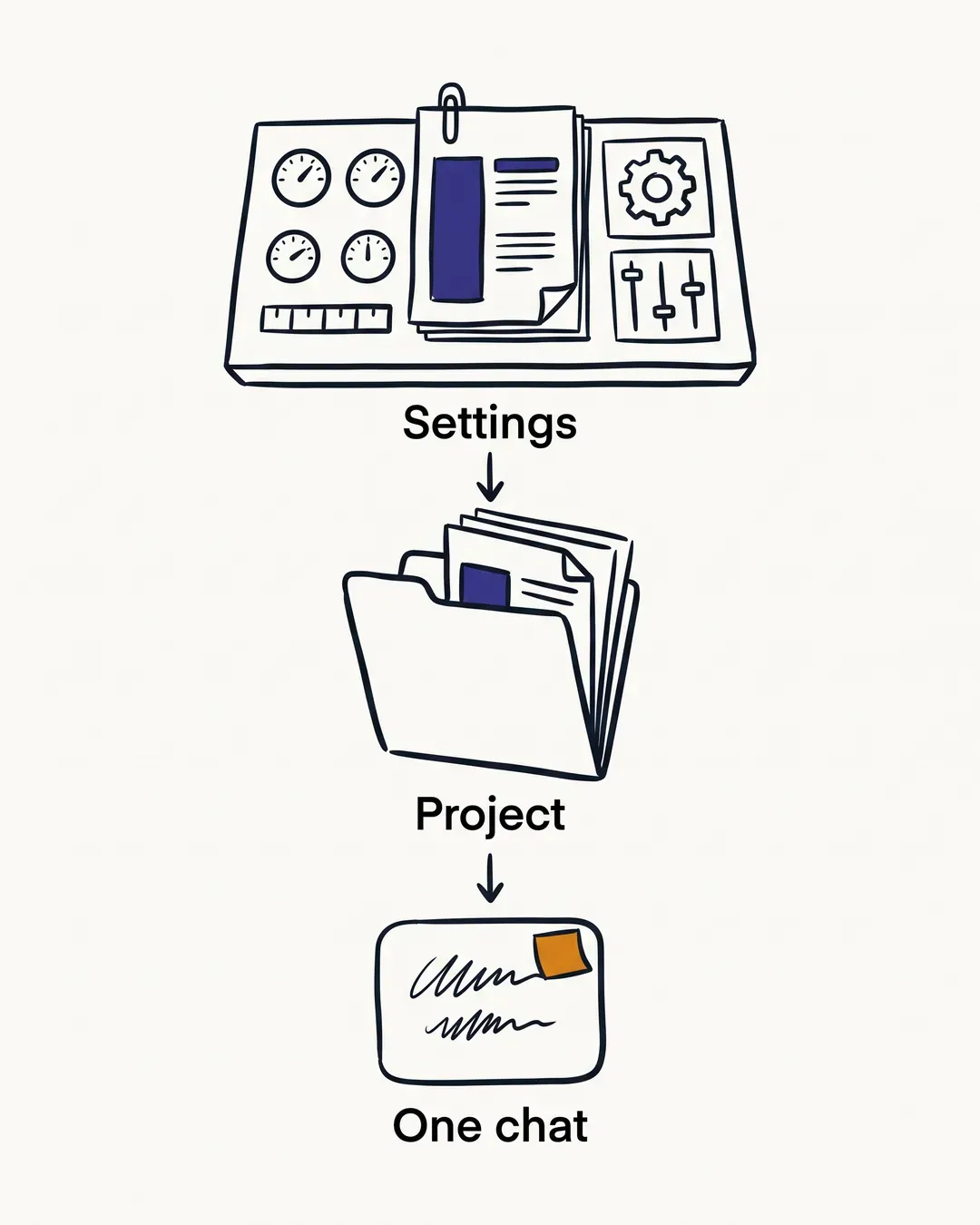
- Open your settings. Go to your profile and click “Personalize.”
- Paste your style description. Custom instructions accept preferences on tone, level of detail and areas of focus. Paste in the one-page guide from the example below.
- Turn on memory if you want it. With memory enabled, OpenAI says ChatGPT can remember your style preferences across conversations, including recurring details like preferred formats, terminology and audiences.
- Use project instructions for one body of work. A newsletter, a book or a client account can each get its own project with style and tone rules that apply only there.
- Adjust in the chat when needed. OpenAI’s example: “Draft this in a casual, conversational tone as if writing a team Slack update.”
The Academy page doesn’t say which ChatGPT plans include custom instructions or memory. Check the Custom Instructions and Memory FAQ articles it links in OpenAI’s Help Center against your own plan.
OpenAI describes GPT-6.2 Sol as a model that “writes clearly and naturally” and says GPT-6.2 Astra can carry a slide template’s writing style into new slides. Those are OpenAI’s own claims. The independent five-model study above found prompting strategy outweighed model size among the Llama, Qwen and Mixtral models it tested.
How well can AI really imitate an everyday writer’s style?
AI imitates an everyday writer’s style only partly, and worst in informal writing such as blogs and forum posts. Most of this research is recent and much of it is preprints, so treat the findings as a snapshot.
Everyday writers
The everyday-author study ran over 40,000 generations per model across news, email, forums and blogs, using writing from more than 400 real authors. Models approximated user styles in news and email but struggled with “nuanced, informal writing in blogs and forums.” The authors describe a “fundamental gap” in personalized AI writing.
Famous authors and literary styles
Imitations of well-known writers are still easy to spot. A study of GPT-4o, Gemini 1.5 Pro and Claude Sonnet 3.5 imitating Walt Whitman, William Wordsworth, Donald Trump and Barack Obama found the output remained highly detectable, even to a model trained on just eight style features. In French, a style classifier scored 0.947 to 1.00 on real texts by Proust, Céline and Yourcenar but 0.664 on AI imitations, which is well above the one-in-three chance level but far from a match. That paper sums up the field this way: AI reproduces salient features in literary settings and struggles with implicit styles elsewhere.
Matching your style is different from sounding human
A draft can match your habits and still read as machine-made. In the five-model study, human essays averaged a perplexity of 29.5 while matched AI outputs averaged only 15.2, meaning the AI text was far more predictable. The authors conclude that “stylistic fidelity and statistical detectability are separable.” The famous-author study likewise found perplexity was the main feature separating AI text from human text.
Why does AI editing flatten personal voice, and how can you keep yours?
AI editing flattens personal voice because large language models pull text toward a more polished, less situated register, and in one study that pull held under every prompt tested. That 2026 study had three frontier models rewrite 300 personal narratives under three kinds of prompt: generic improvement, rewrite-only and voice-preserving revision. Measured across 13 linguistic markers, the results pointed the same way every time:
Checklist
- Count your contractions and your "I"s against the original and put them back where they vanished.
- Restore your reasoning: undo rewrites that turned "because" into compressed abstraction.
- Swap long words for your short ones.
- Compare the draft against your past writing.
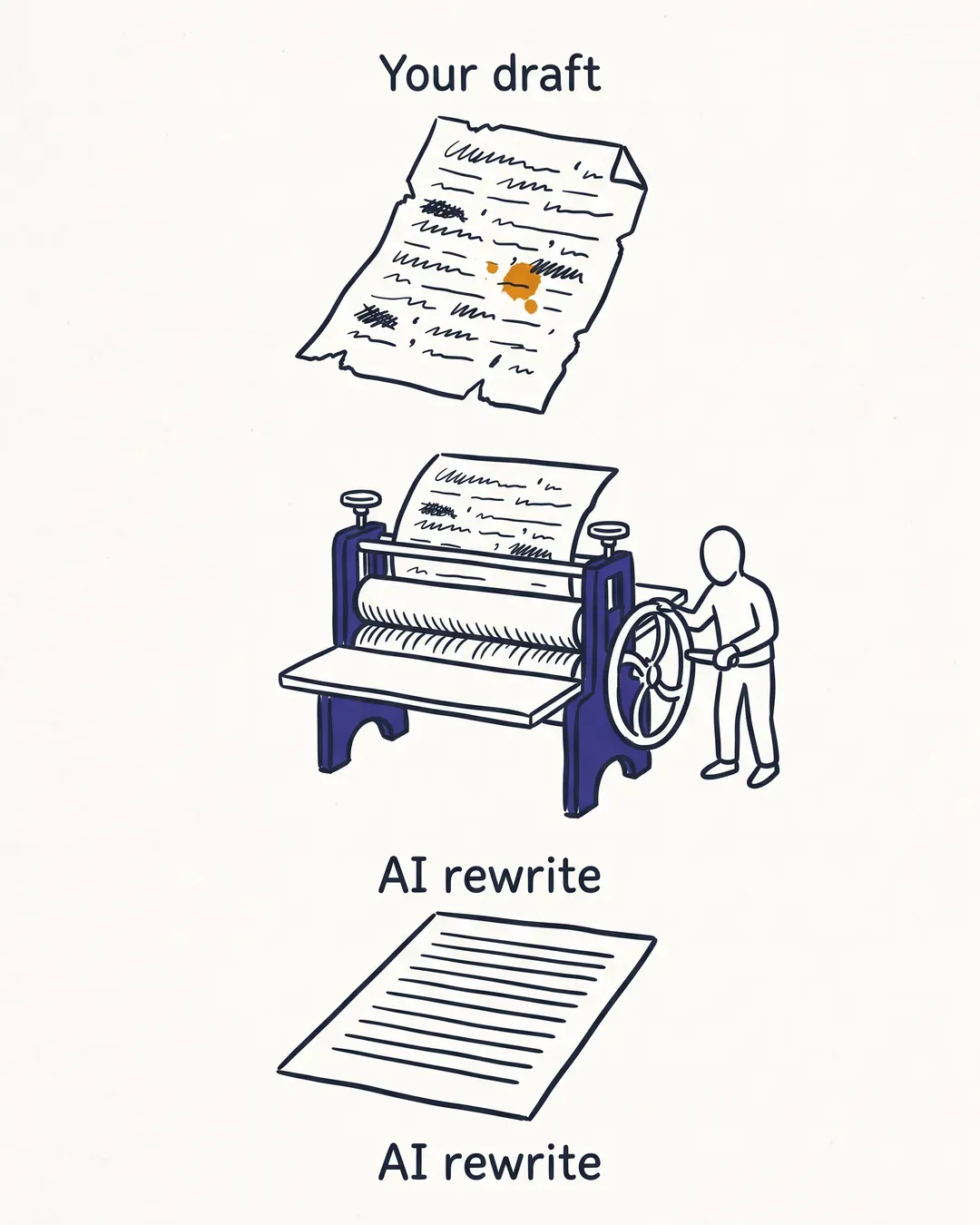
- Function words, contractions and first-person pronouns went down.
- Vocabulary diversity, word length and fancier punctuation went up.
- Narration moved from inside the experience to a distance, and explicit “because” reasoning turned into compressed abstraction.
- Rewritten texts converged and became harder to match back to their source texts.
Voice-preserving prompts reduced the size of these changes but did not reverse their direction. Stylometry itself has the same weak spot: Wikipedia notes the method is vulnerable to distortion of text during revision.
To keep your voice:
- Check the markers after every pass. Count your contractions and your “I”s against the original. Put them back where they vanished.
- Restore your reasoning. If “I switched vendors because the invoices kept arriving late” became “Vendor reliability concerns prompted a change,” undo it.
- Swap long words for your short ones. Rising word length was one of the measured shifts.
- Compare against your past writing. The tone checker on this site flags phrases that read as machine-made and lets you compare a draft with earlier writing. For a list of the usual giveaways, see the guide to signs of AI writing.
What other ways can you capture your voice for AI drafts?
Another way to capture your voice is to start from your own spoken or written answers instead of a prompt, so the raw material is already in your words. You can do this with any tool.
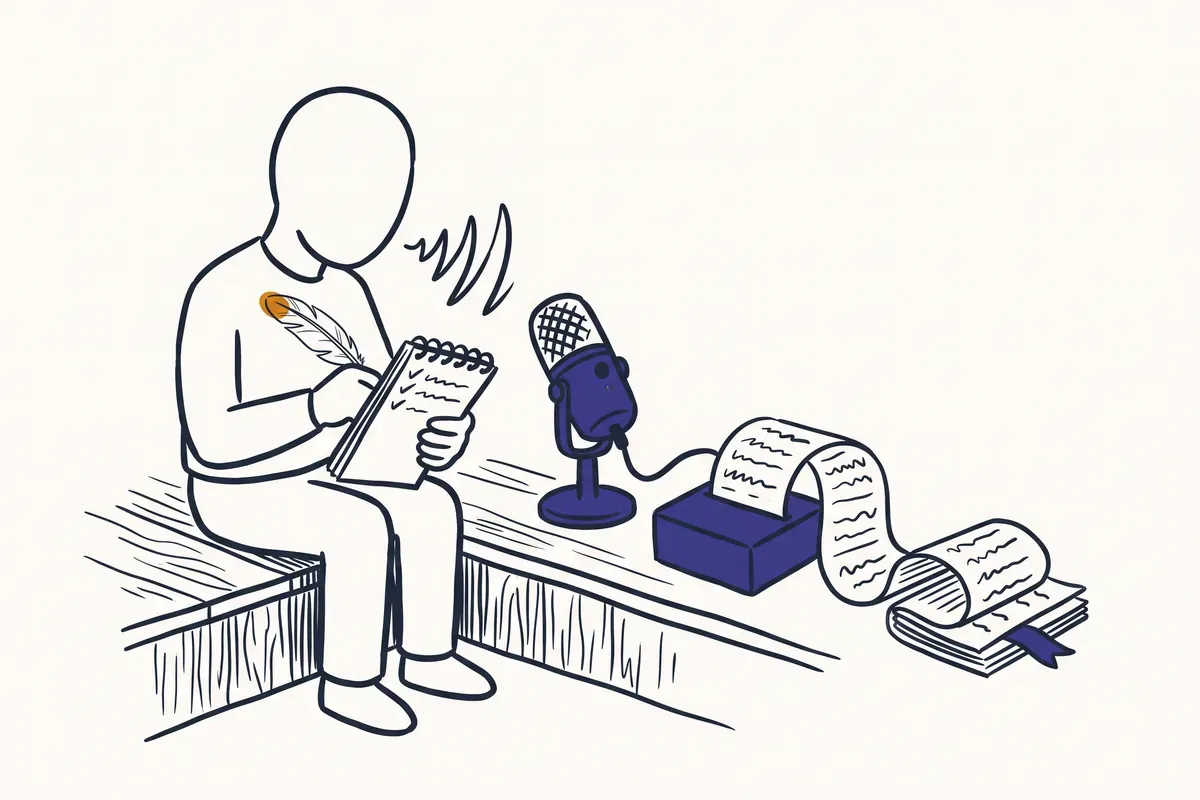
- Interview yourself. The interview question generator on this site makes questions for yourself, in the order an interview runs. Record your answers, transcribe them, and use the transcript as your draft’s raw material or as an extra sample.
- Use an interview-first drafting tool. The free AI ghostwriter on this site interviews you first, then drafts a post, article intro, newsletter or story from your answers, with no sign-up.
- mull works the same way for posts. It asks one question at a time, quotes your own words back and asks for what’s missing, such as the moment, the number or what it led to. Before it writes, it shows you every name, number, date and quote it heard so you can correct them. It then drafts in your voice and marks any sentence your confirmed facts don’t support. You edit by saying what to change, and every version is kept. Plans: Free gives 3 posts in total with no card, Starter is $19 a month for 10 posts a month, and Pro is $39 a month for 30 posts a month. ChatGPT is the better fit when you want a quick rewrite or any task beyond posts, since its custom instructions and projects apply to whatever you bring and you don’t have to answer questions first.
- Hire a person. If you’d rather hand the whole job over, the guide on how to hire a ghostwriter walks through it.
What does a one-page AI writing style guide look like?
A one-page AI writing style guide is a short document listing your habits in plain rules, plus a few samples, that you paste into custom instructions or a project. Here’s one filled in.
Before
In the ever-evolving world of small business finance, staying organized is crucial. By leveraging modern tools, business owners can streamline their bookkeeping processes and ensure accuracy.
After
Last Tuesday I sorted a shoebox of receipts for a client. It took four hours. Snap a photo of each receipt the day you get it, and you won't pay me for those four hours, because sorting is most of the job.
Example: you’re a freelance bookkeeper who sends a monthly newsletter to small-business clients. Your guide might read:
MY WRITING STYLE: CLIENT NEWSLETTER
Sentences: mostly 8 to 15 words. At most one long sentence per
paragraph, usually followed by a short one.
Contractions: always (I'm, you'll, don't).
Person: first person singular. "I", not "we".
Openings: start with a specific (anonymized) client situation or a date.
Punctuation: dashes for asides. No semicolons. No exclamation marks.
Words I use: "honestly", "receipts", "the short version".
Words I never use: "leverage", "streamline", "solutions", "crucial".
Reasoning: always say why a tip matters ("because...").
Tone: friendly and a little dry. For the year-end tax letter, more formal.
Samples: [paste three past newsletters written without AI]
Before (a generic AI draft with no guide):
In the ever-evolving world of small business finance, staying organized is crucial. By leveraging modern tools, business owners can streamline their bookkeeping processes and ensure accuracy.
After (the target your guide describes):
Last Tuesday I sorted a shoebox of receipts for a client. It took four hours. Snap a photo of each receipt the day you get it, and you won’t pay me for those four hours, because sorting is most of the job.
Edit whatever the AI produces toward your guide, then check the result against your own rules: contractions present, “I” present, a reason given, none of your banned words.
What to do next
Your next step is a one-page style guide built from three to ten pieces you’ve already written, saved in ChatGPT and tested against your own work.
- Pull three to ten pieces you wrote without AI help, all of the kind you most want help with.
- Run them through the writing style analyzer, or count sentence lengths, contractions, “I”s and punctuation by hand.
- Write your one-page guide using the example above as a template, including the words you never use.
- In ChatGPT, go to your profile, click “Personalize” and paste the guide. For a single newsletter or book, put it in that project’s instructions instead.
- Test it: ask for a draft of something you’ve already written, then compare the two line by line for contractions, “I” and sentence mix.
- After every AI edit from now on, check those same markers and put back what the edit removed.
Prices and features as of Nov 28, 2026, from each product's own pages.
Frequently asked questions
How do I get AI to write in my style?
Give it both a description and examples. The authors of a 2025 study of more than 400 real-world authors say personal style is often "subtle and implicit, making it difficult to specify through prompts". Save both your description and your samples so you don't have to retype them in every chat.
Can I train ChatGPT to write like me?
OpenAI's Academy page uses the phrase "training ChatGPT with style samples" for mirroring a brand voice in campaign copy. In practice that means pasting examples of your writing and asking it to mirror them. With memory on, it can also recall your preferred formats, terminology and audiences across conversations.
What is my writing style, and can it be measured?
Yes. Your style is the set of habits that repeat in your writing, and those habits have been used to settle real authorship disputes. Frederick Mosteller and David Wallace resolved the disputed authorship of twelve of The Federalist Papers with this kind of analysis. Free software such as JGAAP and the stylo package for R makes the same methods usable by non-experts.
Does my writing style change over time?
It can, so pull recent samples when you set up an AI tool. Stylometry researchers point to Plato, who adopted different stylistic policies in his early and middle dialogues. If your emails from five years ago sound unlike you today, leave them out.
Can AI copy someone else's writing style?
Partly. One study on French literature found an author classifier scored 0.664 on AI imitations of Proust, Céline and Yourcenar, against 0.947 to 1.00 on the authors' real texts. Chance was one in three. Imitating another person's style is also a known way to hide authorship: Wikipedia's stylometry article lists it as one approach in adversarial stylometry.
How do I make AI writing sound human?
Research points to two things AI imitations lack: feeling and variety. A study of imitations of Whitman, Wordsworth, Trump and Obama found the models matched syntactic complexity and readability but did not fully replicate the "affective density and stylistic variance" of the human texts. Those are the gaps to look for when you edit an AI draft.
Sources
- Catch Me If You Can? Not Yet: LLMs Still Struggle to Imitate the Implicit Writing Styles of Everyday Authors
- How Well Do LLMs Imitate Human Writing Style?
- Voice Under Revision: Large Language Models and the Normalization of Personal Narrative
- Decoding AI Authorship: Can LLMs Truly Mimic Human Style Across Literature and Politics?
- Measuring Embedding Sensitivity to Authorial Style in French: Comparing Literary Texts with Language Model Rewritings
- Customizing ChatGPT - Resource | OpenAI Academy
- Stylometry - Wikipedia
- OpenAI | Research & Deployment
- Introducing GPT-6.2 Astra and Sol | OpenAI