In AI-assisted writing, you supply the ideas and the final wording, and AI helps you plan, question you and edit. In a Science experiment, AI help cut writing time by 40% and raised quality by 18%. Other studies find it makes different writers sound alike. Start from your own material, let AI question you, and rewrite every draft yourself.
Key takeaways
- In the Noy & Zhang experiment published in Science, ChatGPT cut average task time by 40% and raised rated quality by 18%. The tasks didn't require factual accuracy or company context.
- Writing with InstructGPT made essays by different authors more similar, and the study traced the extra sameness to the model's text rather than to what the users wrote themselves.
- In a 2026 preprint, AI first drafts were 45% more similar to each other than the final stories people edited from them.
- The Authors Guild recommends publicly disclosing any substantial use of AI to generate text, for example in a book's front matter.
- According to the Authors Guild, AI-generated text can't be copyrighted and must be disclosed and disclaimed when you apply to register a work.
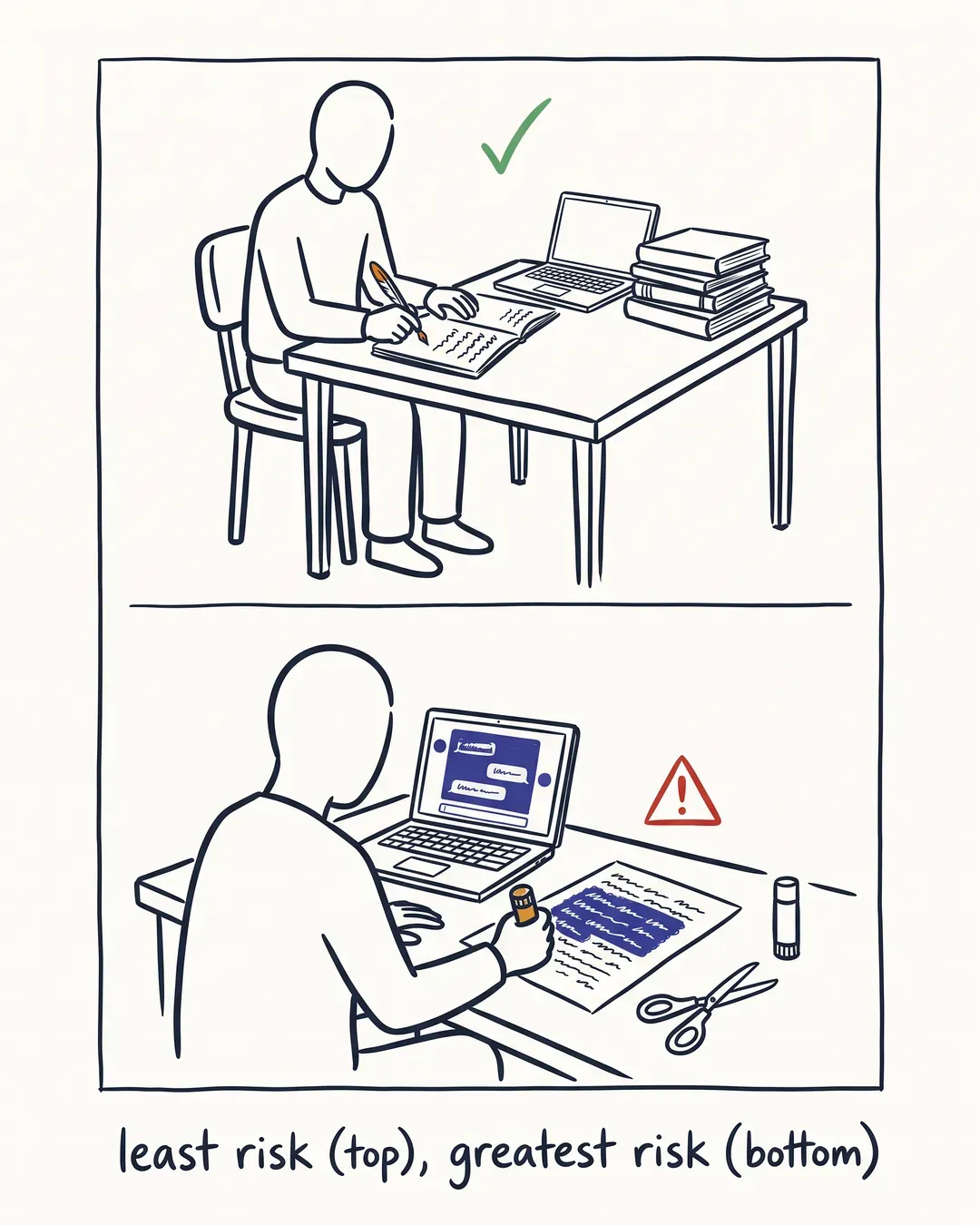
In this guide, AI assisted writing (usually spelled AI-assisted writing) means writing where you stay the author and a tool such as ChatGPT helps along the way, as opposed to publishing what the tool wrote. The Authors Guild’s AI best practices treat AI use as a spectrum, with the most risk at the end where AI output is copied straight into your work. Where you sit on that spectrum affects how your writing sounds and what you can copyright.
The research has two sides. In one experiment, AI help made professionals faster and got their work rated higher. Other studies find that writing with AI pulls different people’s work toward the same words. The workflow below aims to keep the speed and protect your voice: start from your own ideas, let AI structure your material and question you, then rewrite the draft yourself.
| Question | Short answer | Where it comes from |
|---|---|---|
| Does AI help you write faster? | In one experiment, average time fell 40% and rated quality rose 18% | Noy & Zhang abstract, Science |
| Does it make writing sound the same? | Essays written with InstructGPT were more similar to each other than essays written alone | Content diversity study on arXiv |
| Does editing help? | AI first drafts were 45% more similar to each other than the final stories people edited from them | 2026 incentives preprint on arXiv |
| Do you have to disclose? | The Authors Guild recommends publicly disclosing any substantial use of AI to generate text | Authors Guild best practices |
| Can you copyright it? | AI-generated text can’t be copyrighted and must be disclaimed when you register | Authors Guild best practices |
What is AI-assisted writing, and how is it different from AI-generated writing?
The difference between AI-assisted and AI-generated writing comes down to how much of the final text the AI produced, and the Authors Guild’s AI best practices for authors describe it as a spectrum of use. The page says different uses of AI raise different concerns. Copying AI-generated output directly into text presented as professionally human-authored creates “the greatest risks and ethical concerns.” Background uses, such as research where you don’t let the AI think for you or let its output into your work, “present the least.”
In a controlled essay study, Does Writing with Language Models Reduce Content Diversity?, writers could press Tab to get five suggested continuations, then accept and edit one or reject them all. On average, 0.32 of an essay was machine-written with InstructGPT and 0.35 with GPT3. Most essays fell between 0.2 and 0.5.
Does AI actually make writing faster or better?
For short, clearly defined tasks, AI made writing both faster and better in an experiment published in Science. Shakked Noy and Whitney Zhang gave occupation-specific writing tasks to 453 college-educated professionals (the figure in the published abstract) and gave half of them ChatGPT. Average time fell by 40% and output quality rose by 18%. Inequality between workers also decreased.
40 %
Fall in average time on the writing tasks for professionals given ChatGPT
Source: scale.stanford.edu, as of Nov 29, 2026
18 %
Rise in rated output quality
Source: scale.stanford.edu, as of Nov 29, 2026
453
College-educated professionals in the experiment
Source: scale.stanford.edu, as of Nov 29, 2026
11 minutes
How much faster the ChatGPT group finished tasks that took 20 to 30 minutes
Source: news.mit.edu, as of Nov 29, 2026
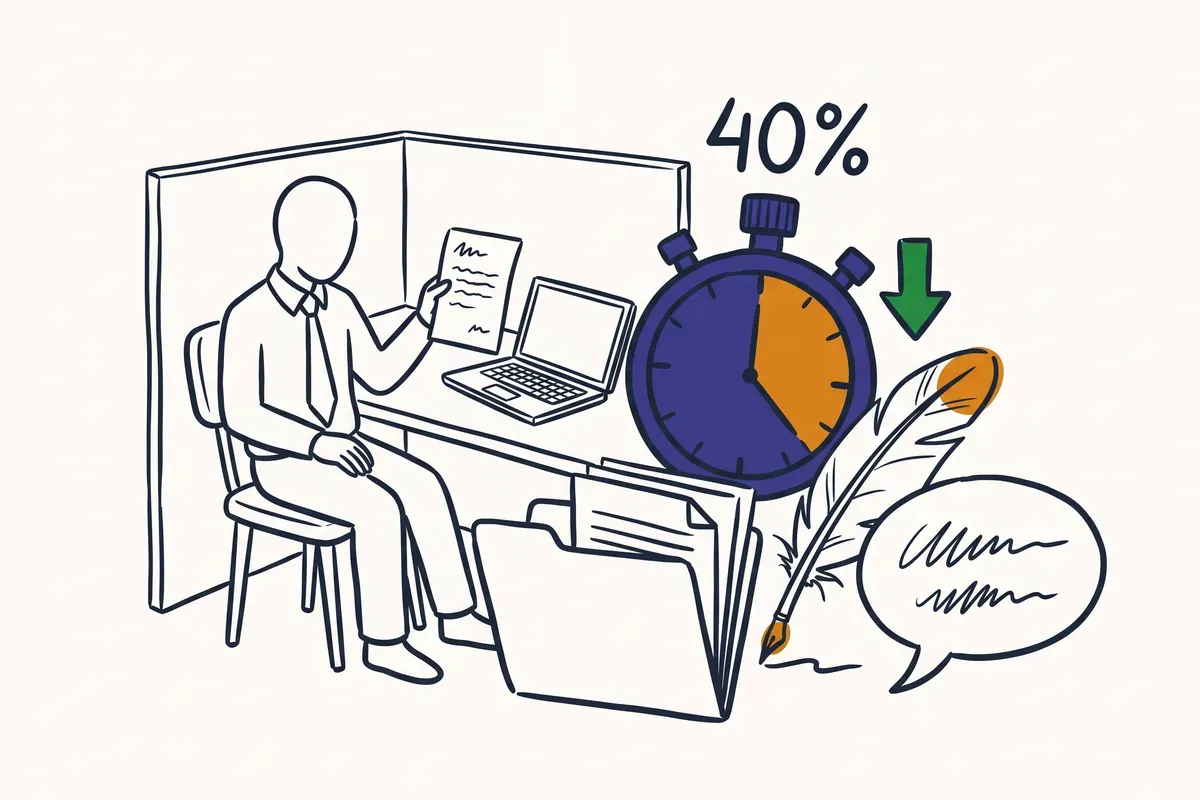
MIT News reports that the tasks took 20 to 30 minutes and included cover letters for grant applications and emails about restructuring. The ChatGPT group used ChatGPT-3.5 and finished 11 minutes faster. Workers who scored lower on the first task gained more from the chatbot on the second.
The researchers noted a number of limitations in their study:
- The tasks didn’t require precise factual accuracy or context about a company’s goals or a customer’s preferences.
- Each assignment came with explicit instructions, while real work may be more open-ended.
- The researchers didn’t think it was feasible to hire fact-checkers to evaluate the accuracy of the outputs, and MIT News calls accuracy “a major problem” for generative AI.
Noy put it this way: “The experiment demonstrates that it does bring significant speed benefits, even if those speed benefits are lesser in the real world because you need to spend time fact-checking and writing the prompts.”
A 2026 preprint on creative writing found a smaller gain. In Incentives shape how humans co-create with generative AI, participants with AI spent 18.6 minutes writing on average, against 20.6 minutes for those writing alone. The authors give two likely reasons. Participants were rewarded for high-quality or highly original writing, which may have limited how far they could lean on AI to save time. And reading, judging and revising model output adds its own mental overhead under a fixed time limit.
Why does AI-assisted writing often sound the same?
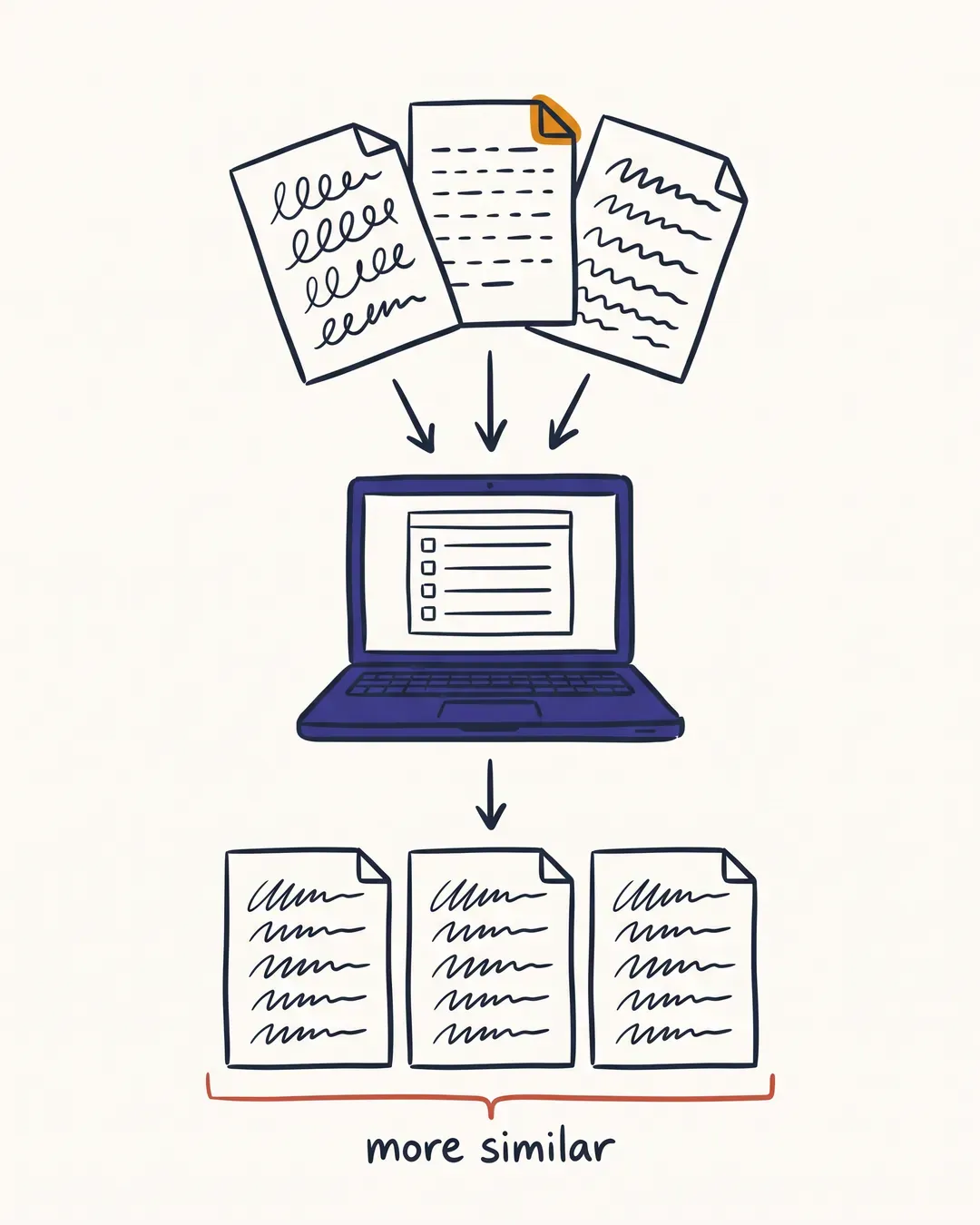
AI-assisted writing can sound alike because, in at least one study, the model’s own suggestions were less varied than what people wrote. In the InstructGPT essay study, writing with InstructGPT made essays by different authors more similar and reduced lexical and content diversity. Writing with GPT3 didn’t produce a statistically significant reduction in overall diversity. The text the users wrote themselves “remains largely consistent with and without model help,” so the authors trace the sameness to the less varied text InstructGPT contributed. Human ratings of a sample of essays showed no clear quality difference between the groups.
What the 2026 preprint adds
The 2026 incentives preprint is posted on arXiv, so treat it as an early finding. Full AI drafts were “strikingly similar,” and many stories opened with “I woke up in…”. Participants rarely kept these drafts as they were. The final stories they edited were noticeably more varied, and the AI first drafts were on average 45% more similar to each other than those final submissions. Even so, the authors found “a lingering homogenizing effect” compared with writing done without AI.
How people used the AI made a difference. Participants rewarded for originality wrote more varied stories than those rewarded for quality alone. They still used AI, but they took fewer of its suggestions verbatim and used it for brainstorming, proofreading and targeted edits.
What large-scale text shows
A USC study in Nature Human Behaviour, reported by USC News, analyzed more than 880,000 public texts. The narrowing in the range of text complexity was first noticeable in November 2022, coinciding with the launch of ChatGPT. “The finding isn’t that writing got simpler; what was reduced was the diversity,” said first author Zhivar Sourati. After rewriting by a language model, people’s use of “I” and “we” and phrases like “you know” became more uniform. Creative writing on Reddit lost the most variety, and news writing held up best.
If you want to know what that sameness looks like on the page, the post on signs of AI writing lists the common patterns.
What AI-assisted writing workflow keeps your voice?
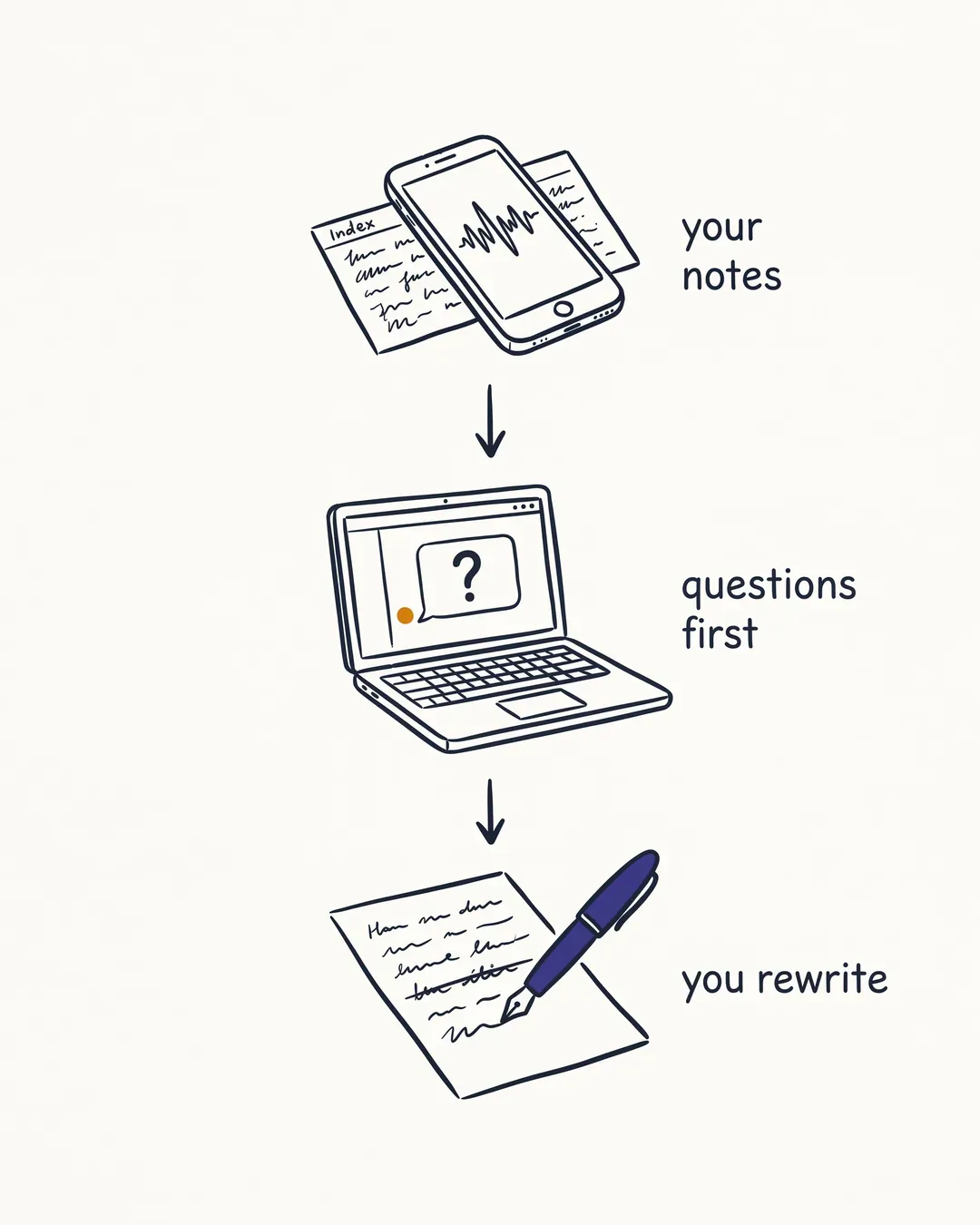
The workflow that keeps your voice puts your own material first, gives AI the jobs of questioning and organizing, and leaves the final sentences to you.
- Get your raw material out before you open a chat: a voice memo or messy notes.
- Ask the AI to question you one question at a time before it writes anything.
- Let the AI suggest an order, using your words and no new claims.
- Write the draft yourself, or rewrite every line of an AI draft.
- Use AI for narrow edits, such as a proofread or one shorter paragraph.
- Fact-check every claim the AI touched.
- Read the result against your past writing.
The Authors Guild’s guidance sums up the aim: “If you are claiming authorship, don’t let AI replace your unique voice, thinking, and creativity.”
How do you get ChatGPT to write in your voice?
To get ChatGPT closer to your voice, give it your own writing and your own raw material, then judge its output against your past work. OpenAI’s GPT-6.2 announcement says GPT-6.2 Astra’s documents “read less like AI, and more closely follow the templates you provide,” with writing that is “more direct and specific, with fewer generic takeaways and less filler.” The same page says Astra can carry a slide template’s writing style into new slides. These are OpenAI’s own claims. The announcement lists both GPT-6.2 models for Plus, Pro, Enterprise and Edu users in ChatGPT Work.
A model that matches a template still isn’t writing from your experience. A practical setup:
- Paste three to ten samples of your writing into a writing style analyzer to get a voice brief: your average sentence length, how you open, the phrases you repeat.
- Give ChatGPT that brief along with your notes or voice-memo transcript, and ask it to keep your phrases word for word wherever it can.
- Compare its version with your samples sentence by sentence, and replace any line you wouldn’t say out loud.
Match your own voice only. The Authors Guild advises against using AI to purposely copy or mimic another writer’s style or voice in ways that harm the value of their works or attempt to profit from them, and says doing so could expose you to claims of unfair competition or copyright infringement.
Do you have to disclose AI use in your book?
The Authors Guild recommends disclosing AI use publicly when you used it substantially to generate text, though it calls its guidance “guidelines, not rules.” Its current best practices say: “Publicly disclose any substantial use of AI to generate text.” You can describe the AI use in a book’s front matter or at the bottom of an article.
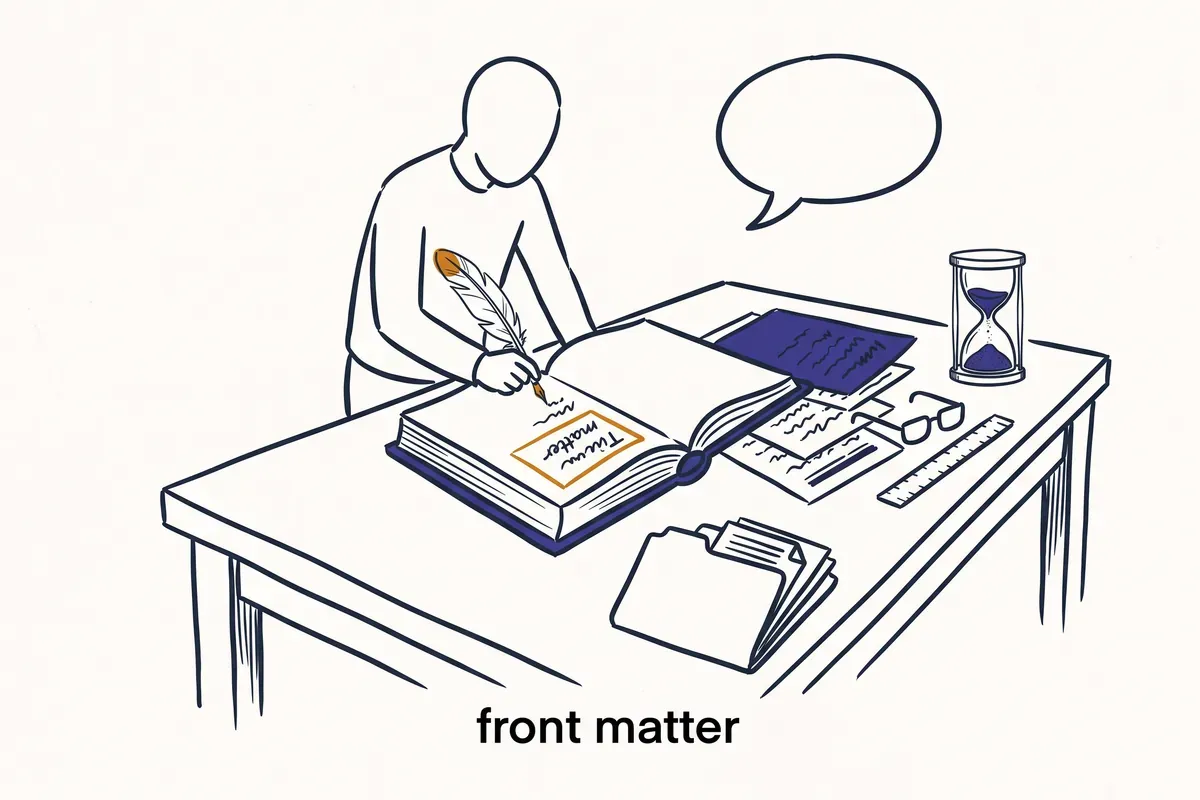
For research and sounding-board use, the page doesn’t ask for public disclosure. It asks you to keep AI in the background and not copy its output into your work, “literally or non-literally.” If you fine-tune a model on your own work to generate new material, it says you should consider and disclose your use of AI to generate any text, because the underlying model was trained on books without permission. It also recommends telling your agent and publisher up front if you’ve included AI outputs.
The Guild first published these practices in February 2024. The announcement of the update says the new version added a section on legal and professional risks, plus a framework for the different kinds of AI use. Older summaries of the Guild’s position may be out of date, so check the current page.
Can you copyright AI-assisted writing in the US?
A work with enough human authorship can be copyrighted as a whole, but the Authors Guild says AI-generated text within it can’t be, because it isn’t original human authorship. Its best practices say any AI-generated text in a work you register must be disclosed and disclaimed in the copyright application, and that text is filtered out before any infringement analysis. Knowingly failing to disclose it “may be deemed fraud on the Copyright Office and invalidate the registration.”
The Guild says its guidance draws on Copyright Office guidance. Its page doesn’t say how much human rewriting turns AI-drafted text into your own authorship.
How do you turn a rough voice memo into a post without losing your voice?
Example: you run a small consulting business and want to post about a mistake you made this week. Here is how the workflow above plays out.
Before
Communication is the foundation of every successful client relationship. Recently, I learned a valuable lesson about transparency that transformed how I approach my business.
After
This week my biggest client got a report two days late. Worse, I hadn't warned them. On Thursday I called and said, "Look, I blew it." Their answer surprised me: it was the first time they felt they knew who they were working with. Now, the moment a deadline slips, I send one line saying so.
Your voice memo (transcribed):
So this week I almost lost my biggest client because the report went out two days late, and honestly it wasn’t even the lateness, it was that I didn’t tell them. I called Thursday and just said, look, I blew it. And they were fine. They said that call was the first time they felt like they knew who they were working with. Lesson is, I don’t know, tell people early.
What a one-line prompt might give you (an illustration of the generic style):
Communication is the foundation of every successful client relationship. Recently, I learned a valuable lesson about transparency that transformed how I approach my business.
Questions to ask the AI to put to you instead:
- “You said ‘I blew it.’ What did the client say right after?”
- “What do you do differently now when a deadline slips?”
Your rewrite, using your answers:
This week my biggest client got a report two days late. Worse, I hadn’t warned them. On Thursday I called and said, “Look, I blew it.” Their answer surprised me: it was the first time they felt they knew who they were working with. Now, the moment a deadline slips, I send one line saying so.
The rewrite keeps your phrase “I blew it,” the two-day figure and the client’s own line. The AI only asked questions and helped with the order.
Where do interview-first tools like mull fit?
Interview-first tools follow the questioning step of this workflow for you. You can also try the prompt above in a chatbot, or use the site’s free AI ghostwriter, which interviews you before it drafts.
mull is one tool built around this idea. It doesn’t write from a prompt. You speak or type what’s on your mind, then it asks one question at a time, quoting your words and asking for the missing moment or number. Before writing, it shows you every name, number, date and quote it heard so you can correct them. It then drafts in your voice and marks any sentence your confirmed facts don’t support. The free plan includes 3 posts in total. Starter is 19 US dollars a month for 10 posts, and Pro is 39 US dollars a month for 30 posts.
ChatGPT covers far more ground. OpenAI’s announcement describes slides, spreadsheets, documents and code, while mull is built for drafting posts from an interview. A human ghostwriter is another route if you’d rather someone else run the interview and do the writing.
What to do next
Start your next piece from your own words, then bring AI in only for questions and narrow edits.
- Record a short voice memo today about one idea you want to publish, before you open any AI tool.
- Paste the transcript into ChatGPT with the prompt from the workflow, and answer its questions until the story has a moment, a number and an outcome.
- Write the draft yourself from your answers, then use AI for one narrow edit, such as a proofread.
- Check every fact the AI touched, and run the final text through a tone checker.
- If the piece is headed for a book or a publisher, read the Authors Guild’s AI best practices, note any AI-generated text for your copyright application, and decide what to disclose in the front matter.
Prices and features as of Nov 28, 2026, from each product's own pages.
Frequently asked questions
Is using AI to write the same as plagiarism?
It depends on how you use it. The Authors Guild's best practices say that generating text and claiming it as your own without substantial revision is generally considered unethical and possibly plagiarism, and so is mimicking another writer's voice or style. The same page calls AI spelling and grammar checks uniformly ethical and professional.
Does AI make writing sound the same?
Several studies say it pushes writing toward the same style. In the USC study reported by USC News, texts rewritten by a language model consistently read as if written by someone older, male, politically liberal, more morally concerned and less empathic. Models that guess personal traits from writing became about 6% less accurate once the text was rewritten.
Can my publisher cancel my book deal over AI-generated text?
In some cases, yes. The Authors Guild notes that book contracts contain a warranty that the manuscript is original to the author, and AI-generated material isn't considered original authorship. If AI text ends up in the final manuscript, that may breach the contract and in some cases allow the publisher to end the agreement. Some publishers also have their own AI rules, so ask your editor.
What happens to AI-generated parts of a copyrighted book?
They aren't protected. The Authors Guild says that if the work as a whole has enough human authorship to be copyrighted, the AI-generated text will be filtered out before any infringement analysis. If your publisher registers the book for you, it needs to know which elements are AI-generated so it can fill in the application correctly.
What should I put in a contract with a ghostwriter about AI?
The Authors Guild recommends a written contract with any ghostwriter, co-author, editor or book coach that bans adding more than de minimis AI-generated text without your written approval. The contract should also require them to disclose their use of AI.
Is it safe to paste my manuscript into a chatbot?
There are risks. The Authors Guild warns that by default, almost all public chatbots can use what you enter to train their models. Uploading drafts or interview transcripts may expose confidential material or conflict with a publisher's exclusivity clause. Most consumer tools have an opt-out setting, but you may need to dig to find it.
Did people keep using AI after the Noy & Zhang experiment?
The study reports relative likelihoods rather than a head count. According to the published abstract, workers who used ChatGPT in the experiment were 2 times as likely to report using it in their real job 2 weeks later, and 1.6 times as likely 2 months later.
Sources
- Study finds ChatGPT boosts worker productivity for some writing tasks | MIT News | Massachusetts Institute of Technology
- Experimental evidence on the productivity effects of generative artificial intelligence | SCALE Initiative
- Does Writing with Language Models Reduce Content Diversity?
- Incentives shape how humans co-create with generative AI
- Is AI making everyone’s writing the same? — USC News
- AI Best Practices for Authors - The Authors Guild
- Authors Guild Updates AI Best Practices for Writers - The Authors Guild
- Introducing GPT-6.2 Astra and Sol | OpenAI
- OpenAI | Research & Deployment